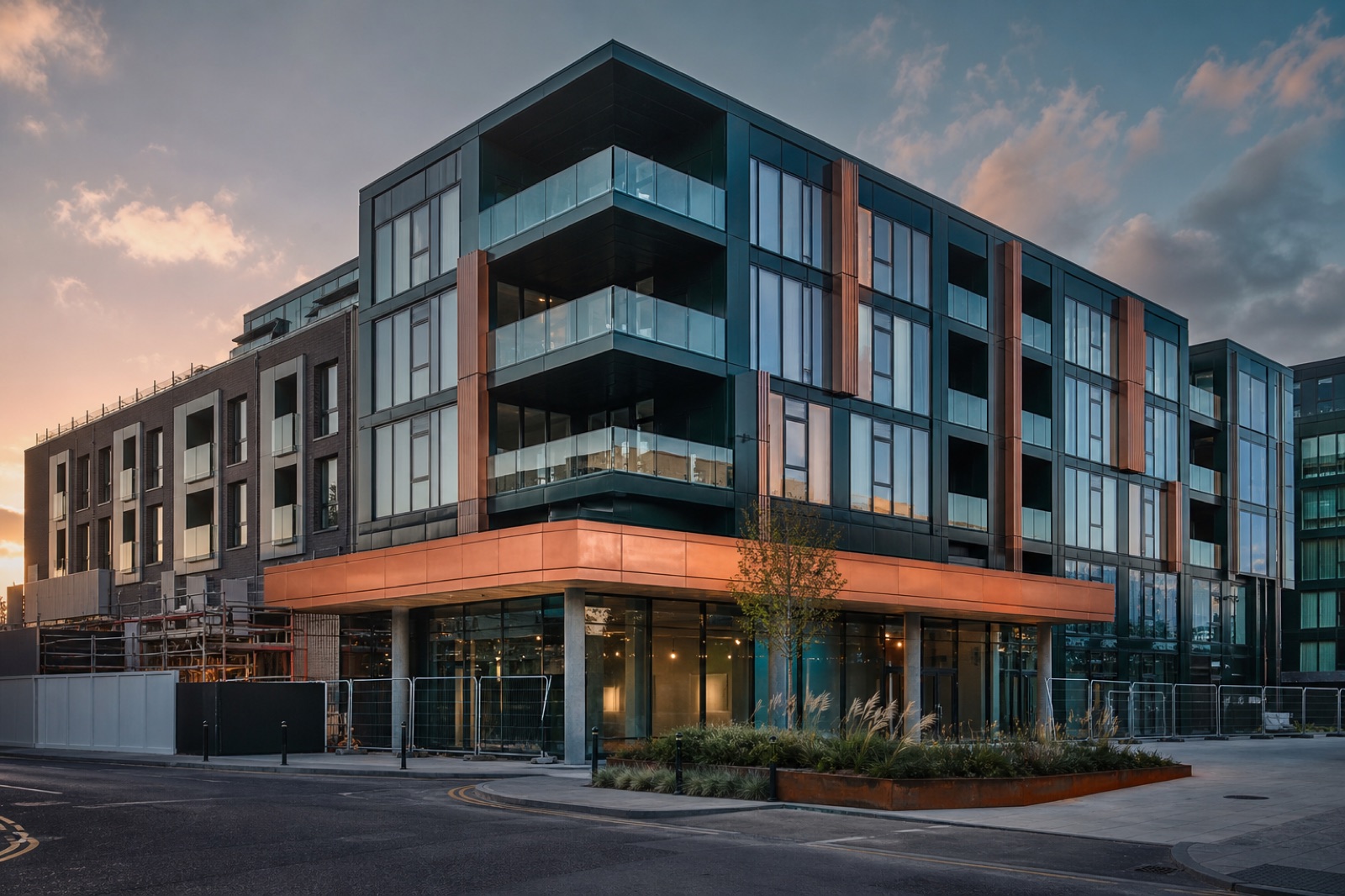
Semi commercial mortgages
Semi commercial mortgages for mixed-use property, the shop, office or pub with flats above and any building that is part commercial and part residential. We structure the case the way semi-commercial lenders underwrite it, for landlords, investors and limited companies, and place it with the right funding desk.

What is a semi commercial mortgage?
A semi-commercial property is a building that is part commercial and part residential, most often a shop, office or restaurant on the ground floor with one or more flats above. Because it mixes uses, it is also called a mixed-use property. A semi-commercial mortgage is the finance arranged against that mixed-use building as a single asset. It sits between a residential buy to let mortgage and a full commercial mortgage: the residential element behaves like buy to let, the commercial element like a commercial let, and the mortgage is underwritten on both together.
Semi-commercial mortgages are arranged through specialist and commercial lenders rather than the high street, because a mixed-use property is valued and let differently from a plain residential or a plain commercial building. Lenders look at the split between the commercial and residential parts, the income each produces, the strength of the commercial tenant and the lease, and the condition and location of the property. A building weighted toward residential often prices closer to buy to let, while one weighted toward commercial is underwritten more like a commercial mortgage. We read the property, the tenancies and the income, tell you what is fundable, and place the semi-commercial mortgage with the lender whose criteria fit, whether the borrower is an individual, a partnership or a limited company.
- A mortgage for mixed-use property, part commercial and part residential
- Typically a shop, office or restaurant with flats above
- Underwritten on both the commercial and residential income together
- Priced between a residential buy to let and a full commercial mortgage
- Arranged for individuals, partnerships and limited companies
Indicative terms
- PropertyA mixed-use, semi-commercial building, part commercial and part residential
- Loan to valueIndicatively up to 70 to 75 percent of value, varying by lender and use mix
- IncomeAssessed on the combined commercial and residential rental income
- BorrowerAn individual, partnership, limited company or SPV
- SecurityFirst legal charge over the whole mixed-use property
- TermInvestment term, commonly a five year fixed rate or a longer commercial term
Indicative only. Terms vary by lender, property and borrower and are not an offer of finance.
Who it suits
- Landlords buying a shop or office with flats above
- Investors refinancing a mixed-use building to release capital
- Owner occupiers trading from the commercial part and letting the flats
- Limited companies holding semi-commercial property in an SPV
Discuss semi commercial mortgages
A view on fundability within one working day.
How we arrange a semi commercial mortgage
Read the property
We review the mixed-use building, the commercial and residential split, the tenancies and the income, and tell you which semi-commercial lenders will fund it and on what indicative terms.
Structure and place
We match the case to the commercial and specialist lenders whose criteria fit the use mix and the borrower, and package it the way they underwrite semi-commercial property.
Valuation and offer
We agree heads of terms, manage the semi-commercial valuation and the legal work, and keep the application moving to a mortgage offer.
Through to completion
We see the semi-commercial mortgage through to completion and line up the next purchase, refinance or capital raise across the portfolio.
Semi commercial mortgage criteria and lending
Semi-commercial mortgage criteria turn on the balance between the commercial and residential parts of the property and the income each produces. Lenders assess the proportion of floor area and value in commercial use against residential use, the strength and length of the commercial lease, the quality of the residential tenancies, and the location and condition of the mixed-use building. A property that is mostly residential with a small commercial unit is often treated close to a residential investment, while one that is mostly commercial is underwritten as a commercial mortgage, and the criteria and pricing follow. Lenders will want to see the tenancy agreements, the rental income, the EPC and, on the residential side, usually an assured shorthold tenancy per flat. Many semi-commercial lenders lend to a limited company or SPV as well as to individuals and partnerships, with directors giving personal guarantees. Vacant possession, a weak commercial tenant or an unusual use can narrow the pool of lenders, which is where the case has to be placed carefully. We know which lenders fund semi-commercial and mixed-use property, how each treats the use split, and which will consider a first-time commercial investor, and we place the case accordingly. All criteria are indicative, vary by lender, borrower and property, and are not an offer of finance.
How much can you borrow on a semi commercial mortgage?
A semi-commercial mortgage is typically arranged up to around 70 to 75 percent loan to value, so the deposit is indicatively 25 to 30 percent of the property value, with the exact figure set by the lender, the use mix and the strength of the income. The loan is sized on the combined commercial and residential rental income against the lender's stress test, and an interest cover ratio is applied much as it is on buy to let, though commercial income is often stressed more conservatively than residential. The valuation is central: a semi-commercial building is usually valued on its investment value from the rental income, so a strong commercial tenant on a long lease and well-let flats above support a higher value and a larger loan. Where the commercial part is vacant or the income is thin, a lender may reduce the advance, and some cases are better funded with bridging loans first, then refinanced onto a term mortgage once the property is stabilised and let. Bridging finance also suits a semi-commercial purchase at auction or one that needs refurbishment, with the works funded much as they would be under development finance and the semi-commercial mortgage arranged as the exit. We model the income and the achievable loan before approaching lenders, using the buy to let mortgage calculator as a starting point for the residential element, so the semi-commercial mortgage goes to market at a level that will fund. The figures are illustrative, vary by lender and property, and are not an offer of finance.
Semi commercial mortgage rates and fees
Semi-commercial mortgage rates sit between residential buy to let rates and full commercial mortgage rates, and depend on the loan to value, the use mix, the strength of the income and whether the borrower is an individual or a limited company. A property weighted toward residential tends to price closer to buy to let, while one weighted toward commercial prices closer to a commercial mortgage. Expect a lender arrangement fee, often a percentage of the loan, a valuation fee that reflects the mixed-use inspection, and legal costs for a more involved title. Semi-commercial products are commonly offered on a five year fixed rate or a longer commercial term, sometimes with a variable margin over a reference rate, and an early repayment charge usually applies. Because rates move with the wider market and with the use mix, we quote current indicative ranges rather than headline figures. We disclose our broker fee in writing and quote the all in cost so cases can be compared properly, and the figures are not an offer of finance.
Semi commercial against commercial and residential property
The difference between commercial and semi-commercial property is the presence of a residential element. A commercial property is wholly business use, an office, shop, warehouse or industrial unit with no living accommodation. A semi-commercial or mixed-use property combines commercial and residential use in one building, such as a shop with flats above, and a residential property is wholly a home. That mix is why a semi-commercial mortgage is underwritten between the two: the residential income behaves like buy to let and the commercial income like a commercial let. For an investor, semi-commercial property can carry advantages over pure commercial, since the residential flats add income and can steady the case if the commercial tenant leaves, and it is often treated differently for stamp duty than a purely residential purchase, though tax is a matter for your adviser and we do not give tax advice. Semi-commercial investment lending arranged for landlords and companies is predominantly unregulated and falls outside the Financial Conduct Authority's regulated mortgage perimeter; where a case would be a regulated mortgage contract, for example an owner occupier living in part of the building, we refer it to an authorised firm. Alongside semi-commercial mortgages we arrange the wider product range that sits around a mixed-use deal: commercial mortgages, bridging loans, development finance and development exit for a scheme being built out or converted, plus bridging loans for a fast or auction purchase and full commercial mortgages where a property is wholly commercial. We also arrange HMO, multi unit freehold block, portfolio and bridge to let finance, so a semi-commercial building can be funded as part of a wider portfolio.
Semi commercial mortgages: common questions
What is a semi commercial mortgage?
A semi-commercial mortgage is finance arranged against a mixed-use property that is part commercial and part residential, most often a shop, office or restaurant with flats above. It is underwritten on both the commercial and residential income together and sits between a residential buy to let mortgage and a full commercial mortgage. We arrange these for landlords, partnerships and limited companies; we are a finance arranger and introducer, not a lender, and terms are indicative and not an offer.
What is the difference between commercial and semi-commercial property?
A commercial property is wholly business use, such as an office, shop or warehouse, with no living accommodation. A semi-commercial or mixed-use property combines commercial and residential use in one building, such as a shop with flats above. The residential element is why a semi-commercial mortgage is underwritten between a buy to let and a full commercial mortgage, and it can change how the property is treated for lending and for stamp duty.
How much deposit do you need for a semi commercial mortgage?
Semi-commercial mortgages are typically arranged up to around 70 to 75 percent loan to value, so the deposit is indicatively 25 to 30 percent of the property value. The exact figure depends on the lender, the balance between the commercial and residential parts and the strength of the income. The figures are illustrative and not an offer of finance.
Is it difficult to get a semi commercial mortgage?
A semi-commercial mortgage is more involved than a plain residential buy to let because the property mixes uses and is valued on its investment income, but a well-let building with a sound commercial tenant and good flats above is a fundable case. The difficulty is usually in placing it with a lender whose criteria fit the use mix, which is where a broker earns their fee. A vacant commercial unit or an unusual use narrows the pool of lenders.
Can a limited company get a semi commercial mortgage?
Yes. Many semi-commercial lenders lend to a limited company or SPV holding the mixed-use property, with the directors giving personal guarantees, as well as to individuals and partnerships. The case is underwritten on the combined commercial and residential income and the structure. We place both individual and limited company semi-commercial mortgages. Whether to hold personally or in a company is a decision for you and your tax adviser.
Are semi commercial mortgages regulated?
Semi-commercial investment lending arranged for landlords and companies is predominantly unregulated and falls outside the Financial Conduct Authority's regulated mortgage perimeter. Where a transaction would be a regulated mortgage contract, for example where an owner occupier lives in part of the building, we refer it to an authorised firm. Portfolio Finance is a finance arranger and introducer, not a lender.
Can I use bridging loans for a semi commercial property?
Yes. Bridging loans suit a semi-commercial purchase that needs speed, such as an auction lot, or a mixed-use building that needs refurbishment before it is fully let. The bridging finance funds the purchase and the works, much as development finance funds a build, and a semi-commercial mortgage is arranged as the exit once the property is stabilised. We arrange commercial mortgages, bridging loans, development finance and semi-commercial products, so the right facility, or sequence of facilities, is matched to the deal. A short bridging loan to buy and the semi-commercial mortgage to hold is a common combination on a mixed-use property. The figures are indicative and not an offer.
What types of property count as semi-commercial?
A semi-commercial or mixed-use property is any building that combines commercial and residential accommodation. The classic example is a shop with a flat above, but the same applies to an office, a restaurant, a pub, a takeaway or a professional practice on the ground floor with one or more flats over it. A parade of shops with residential upper floors, or a building split between commercial units and self-contained flats, is also semi-commercial. What matters to a semi-commercial mortgage lender is the split between the commercial and residential parts and the income each produces, because that split drives both the valuation and the rate.
How is a semi commercial property valued for a mortgage?
A semi-commercial property is usually valued on its investment value, from the combined commercial and residential rental income, rather than only on a bricks and mortar basis. A strong commercial tenant on a long lease and well-let flats above support a higher investment value and a larger mortgage, while a vacant commercial unit pulls the value and the loan down. The valuer weighs the commercial element and the residential element together. Because the valuation basis varies between lenders, placing the case with a lender whose approach suits the property matters. The figures are indicative and not an offer of finance.
How do I apply for a semi commercial mortgage?
You do not apply to a single lender in isolation. We consider the property, the use mix and how much you want to borrow, and we work out which semi-commercial lenders will fund it before any application goes in. Lenders will look at the rental income, the tenancies and the borrower's credit and experience, so a clean, well-packaged application matters. We then apply to the lender whose criteria fit, manage the valuation and the legal work, and see the case through. Adverse credit does not always rule a case out, since some semi-commercial and bridging lenders are more flexible than the high street. The figures are indicative and not an offer of finance.
Are semi commercial mortgage rates higher than residential?
Semi-commercial mortgage rates usually sit above residential buy to let rates and below full commercial mortgage rates, because the mixed-use property carries a commercial element that lenders price for. The exact rate depends on the loan to value, the balance between the commercial and residential parts, the strength of the commercial tenant and whether the borrower is an individual or a limited company. A building weighted toward residential prices closer to buy to let. We quote current indicative commercial and semi-commercial mortgage rates rather than headline figures, and they are not an offer.
Can I get a semi commercial mortgage with a short lease on the commercial unit?
A short remaining lease on the commercial tenant can narrow the pool of semi-commercial lenders, because the commercial income is less secure, but it does not always stop a case. Some lenders will lend where the residential flats carry the property, or where there is a plan to re-let or renew the commercial unit, and bridging loans can hold the property while the lease position is sorted before a term mortgage. We assess the commercial lease and the residential income together and place the case with a lender comfortable with the position. The figures are indicative and not an offer of finance.
Discuss semi commercial mortgages
Send us the portfolio schedule, the rents and the balances and we will come back with a view on structure and likely terms within one working day.